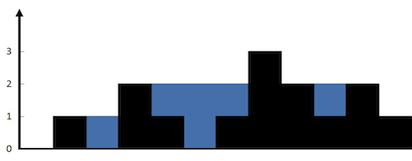
Given n non-negative integers representing an elevation map where the width of each bar is 1, compute how much water it can trap after raining.
Example 1:
Input: height = [0,1,0,2,1,0,1,3,2,1,2,1]
Output: 6
Explanation: The above elevation map (black section) is represented by array [0,1,0,2,1,0,1,3,2,1,2,1]. In this case, 6 units of rain water (blue section) are being trapped.
Example 2:
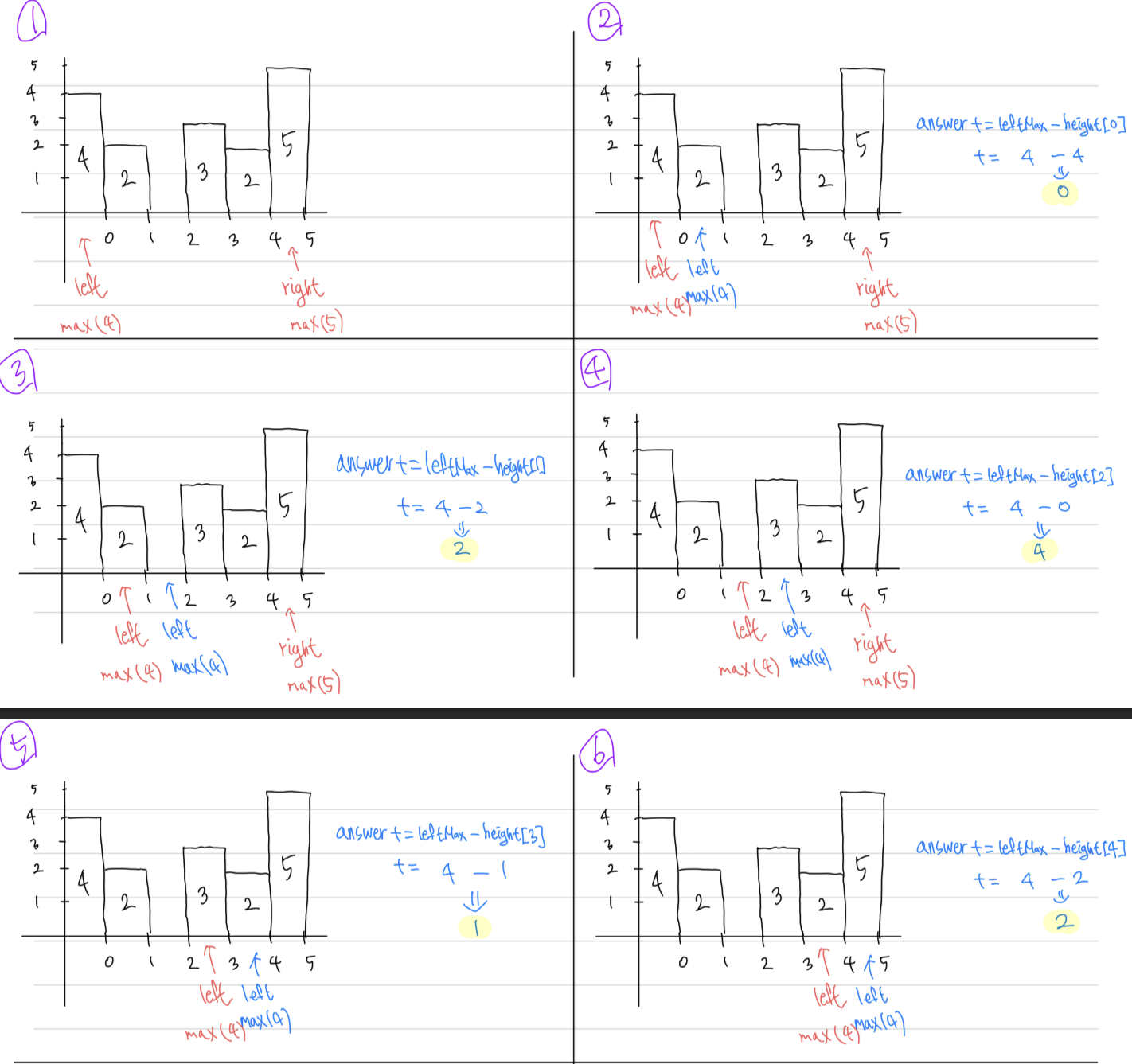
Input: height = [4,2,0,3,2,5]
Output: 9
Constraints:
n == height.length
1 <= n <= 2 * 104
0 <= height[i] <= 105
문제 풀이
접근 방법 (투 포인터를 이용하여 해결)
맨 왼쪽, 맨 오른쪽의 포인터를 2개 두어 범위를 좁혀 오면서 계산
범위를 좁히는 기준 -> 둘 중 더 작은 곳을 이동
해당 위치에서 계산을 하기 위해 leftMax, rightMax를 설정 -> 어떠한 높이 기준으로 계산을 할 건지 필요하기 때문